

Comparing homes works best when you can explain the difference without pointing only to a total. One home may support the daily journey you want, while another provides a room arrangement that fits your household better. A score can organise those preferences. It cannot establish the facts you have not checked or decide which compromise you should accept.
This chapter completes the home-buying guide. Bring the brief from search preparation, the observations from neighbourhood checks, and the questions from strata review or house viewing. The aim is a decision record that keeps each kind of information in the right place.
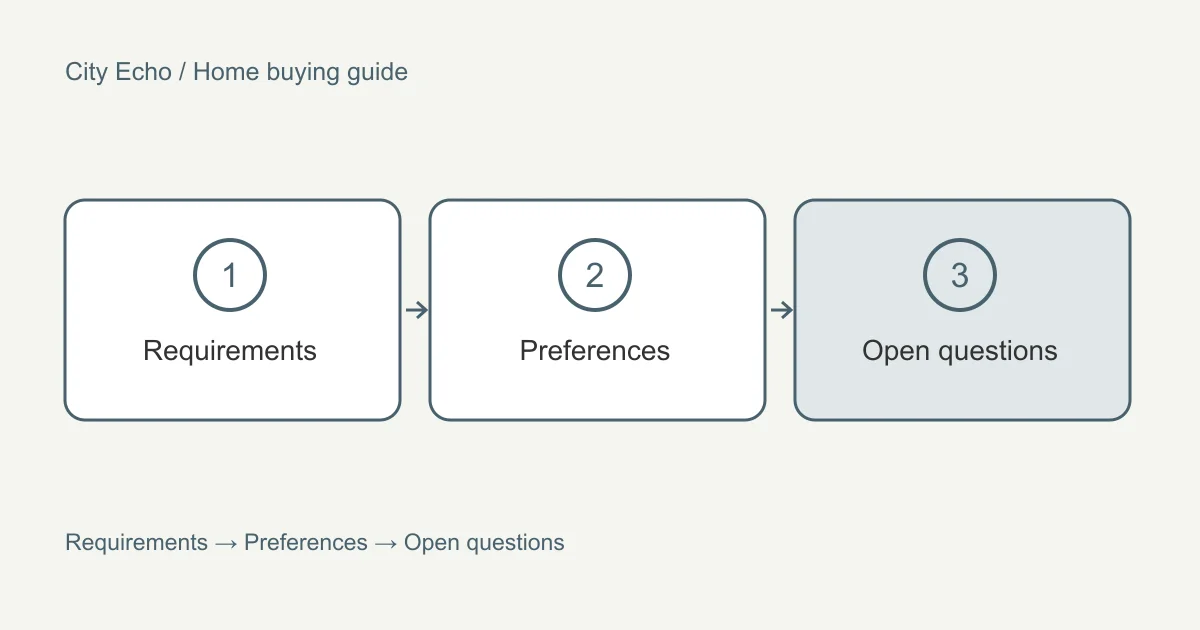
Separate gates, preferences, and evidence
Start with essential requirements. These are the needs whose absence makes the home unsuitable unless an acceptable alternative has been established. Write the consequence of failure beside each requirement. This prevents a collection of attractive extras from compensating for a problem that your household cannot accommodate. If you revise a requirement, explain why and apply the revision to the other candidates.
Next list the preferences you are willing to trade off. These may concern layout, everyday access, storage convenience, or another aspect of your routine. Define each preference in practical terms so that you can apply the same meaning to both homes. Avoid labels that overlap so much that the same benefit is counted repeatedly. For example, commute fit and station proximity may describe the same underlying concern for your household.
Finally, keep an evidence register for questions that are not preferences. A legal arrangement, an inspection finding, or a financing question belongs here. BCFSA's buying guide separates the stages and professional considerations involved in a purchase. Your comparison should preserve those distinctions instead of turning every issue into another rating with the appearance of an answer.
Define a rating before using it
Write what a favourable and an unfavourable result would mean for each criterion. For commute fit, use the actual journey requirements you established. For usable layout, refer to the activities and equipment the home needs to accommodate. A rating becomes more consistent when it points to a specific observation rather than an overall feeling about the property.
Keep a sentence of explanation beside the number. If the explanation includes words such as probably or might, identify what you still need to check. You may have a legitimate preference based on the information available, but the uncertainty should be visible. Do not turn missing information into a middle rating simply to make the table look complete.
Apply the definitions to both homes under the same conditions where possible. If you visited one on a quiet afternoon and the other during a busy period, record the difference. If a room was inaccessible in one home, do not compare a detailed observation with an assumption. The next useful action may be to improve the evidence rather than to refine the scoring scale.
Choose weights from the brief
A weight describes how much influence a preference has in the result. Select the weights before looking for a combination that produces your favourite home. Refer back to the reason the criterion matters. A feature used daily may carry a different importance for you than an occasional convenience, but the decision should come from your routine rather than an abstract rule about what buyers ought to value.
Explain the weights to the other people involved in the search. If someone chooses a different weight, ask which practical consequence they are considering. The disagreement may reveal an essential requirement that has been misclassified as a preference, or a difference in how you expect to use the home. Resolve the meaning of the criterion before combining the ratings.
Keep the set small enough to discuss clearly. Adding criteria is useful when they represent distinct needs, not when they create more opportunities to reward the same attractive feature. The site's home comparison tool provides a bounded exercise using your chosen priorities. Use it after the brief is understood, and retain the fuller evidence record beside the result.
Understand the arithmetic and its limits
The NIST weighted mean reference gives the underlying calculation: multiply each value by its weight, add those products, and divide by the sum of the weights. In this tool, the values are your ratings. The calculation is transparent, but the inputs still express personal judgement rather than an independent measurement of a home.
Consider an explicitly hypothetical example. A layout rating of 4 with weight 3 and a journey rating of 2 with weight 1 produces a score of 3.5: the weighted total is 14 and the combined weight is 4. This illustrates the arithmetic only. It does not establish an appropriate weight for your household or a threshold at which a property becomes suitable to purchase.
A result should always be read with the inputs. If you change a weight, you are changing the relative influence of a preference. If you change a rating, you are changing your assessment of how the home meets it. Neither action improves the property itself. Record the reason for the revision so that a new total is connected to a real change in understanding.
| Part of the decision | Example question | How to record it |
|---|---|---|
| Essential requirement | Can the required access be achieved? | Pass, fail, or unresolved, with evidence |
| Preference | Which layout better supports our routine? | Rating, reason, and weight |
| Factual uncertainty | What arrangement applies to the storage space? | Source requested and person responsible |
| Future scenario | Would a proposed alteration change the fit? | Assumptions and checks still needed |
Examine sensitivity instead of adding precision
After calculating a result, identify which inputs make the difference. Ask whether the preferred home remains ahead if a weight changes in a way you consider reasonable. Ask whether an uncertain rating could change after another visit or document review. This is a discussion of assumptions, not an attempt to create a mathematically guaranteed decision.
If the order changes easily, look at the underlying trade-off. Perhaps the homes serve different routines well, or perhaps you have not decided which preference matters more. A close result can be useful because it shows where another conversation or observation might help. Do not hide that uncertainty by showing extra decimal places or labelling a narrow numerical difference as a decisive win.
If the order stays the same, check the essential requirements and evidence register again. A stable preference score still cannot resolve a title question, confirm financing, or replace an inspection. The federal home inspection information provides context for that separate assessment. Keep the score in its role as a summary of selected preferences.
Compare the current home and future plans separately
A home may appeal because of what you could change. Record that scenario alongside the current assessment, with the proposed work and unanswered questions. Ask what approvals, professional assessments, quotations, and arrangements would need to be established. Do not award the future benefit to the present home before understanding the dependency.
The same distinction applies to location changes. A proposed transport project or nearby development can be relevant, but it needs a dated official source and its own assumptions. Keep your current-route assessment intact. The neighbourhood chapter explains how to use present service and future possibilities without treating them as the same evidence.
When a future scenario drives your interest, discuss what happens if it does not occur as expected. Would the home still meet the essential brief? Would the arrangement remain acceptable for your household? These questions make the dependency concrete. The purpose is not to dismiss future potential, but to avoid treating an unverified possibility as an existing feature of the purchase.
Write the decision in ordinary language
Finish with a short explanation of the current preference. State which needs each home meets, which trade-off matters most, and which questions still affect the decision. Someone reading the explanation should understand the result without needing to reverse-engineer a spreadsheet. Retain the ratings and sources behind it for the next discussion.
Decide what happens next. A candidate may need another visit, a document response, or a conversation with a professional. It may also leave the shortlist because an essential requirement cannot be met. Each outcome can move the search forward when the reason is clear. Avoid continuing to collect information simply because it feels more comfortable than acknowledging an unresolved choice between priorities.
Use the comparison tool to prepare a summary for an enquiry if that would help. Include the questions you want to discuss, not just the scores. Return to the main guide to coordinate the next stage with your professional. A useful comparison helps you ask the next question; the purchase decision still depends on the property, the evidence, and the terms that apply to you.