

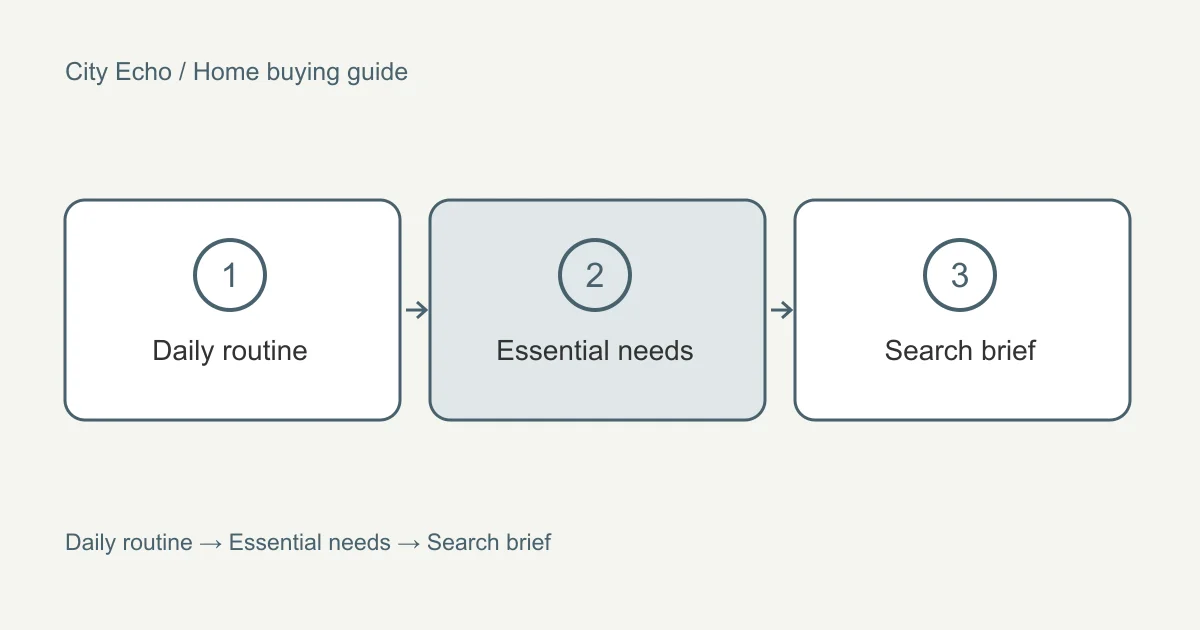
Preparing a home search means translating the way you live into questions that a listing, a visit, or a professional can answer. The brief should help you decide where to spend attention. It should also reveal when a home only appears to fit because you have filled a gap in the information with an optimistic assumption.
Use this chapter before booking a series of appointments, or return to it when your shortlist becomes difficult to explain. It sits within the home-buying guide. The neighbourhood checks chapter examines location, while comparing homes explains how to use the brief after you have seen actual properties.
Describe a normal day before a dream home
Begin with what happens before you leave home and after you return. Where do coats, shoes, deliveries, and equipment go? Where does someone take a private call? What happens when another member of the household is sleeping? These questions reveal useful details about storage, circulation, and separation that a room count cannot show by itself. Write down the activity first, then the space that might support it.
Include the routines that happen less often but still matter. A visitor staying overnight, a relative who needs step-free access, or a work project that occupies a table may change how a layout functions. You do not need a dedicated room for every occasional activity. You do need to know what would move, who would be inconvenienced, and whether the arrangement is acceptable to the people sharing the home.
Bring the brief back to current needs before adding future plans. A room that could become an office after a renovation is different from a room you can use on moving day. Record the existing solution and the proposed change separately. If the purchase depends on that change, it belongs on the investigation list rather than being treated as an already satisfied requirement.
Convert broad wishes into tests
Replace “enough space” with the things that need to fit. Measure the furniture you intend to keep, including space to move around it. At a viewing, ask permission before measuring or opening storage. Note any area you could not assess. A floor plan can help you plan the visit, but do not silently treat an approximate drawing as a measurement of every usable opening and corner.
Replace “quiet” with the activities affected by sound. A person working from home may care about speech privacy between rooms. Someone working nights may care about daytime noise near a bedroom. Describe the concern in your notes and record the conditions under which you listened. A short visit offers an observation, not a prediction about every hour of the week.
Use the same approach to outdoor space, parking, and access. If you need to carry a bicycle from the entrance to storage, investigate that route rather than merely checking a storage box. For strata properties, the province notes that parking and storage allocations can differ. Ask how the right to use the space is documented before relying on what you saw during a visit.
Agree on essentials before discussing scores
An essential requirement should operate as a decision gate. If the home cannot meet it and no acceptable alternative has been established, a collection of attractive extras should not compensate for the failure. This is particularly useful when several people are searching together. Ask each person to explain the consequence of a missing feature rather than arguing only about how much they like it.
Keep preferences separate. Preferences can be traded off: a layout you like more may come with a journey you like less. The point is to make the exchange visible. Write a sentence explaining why each preference matters, then use that sentence when comparing homes. If you cannot explain a rating in terms of the brief, you may be scoring the mood of the appointment rather than the feature.
Revisit the essential list when new information arrives. Perhaps a different storage arrangement solves the problem you had associated with an extra room. Perhaps an access issue is harder to accommodate than you expected. Change the brief when the reason is sound, and record the revision. Apply it to the whole shortlist so that the newest home is not assessed under a more generous set of rules.
Prepare the budget questions without guessing answers
Create a separate financial question list. Ask a mortgage professional what information they need about you and the property. Distinguish the amount you might be able to borrow from the amount you are comfortable committing to your household's housing costs. This chapter does not calculate either amount, and a listing filter cannot establish them for you.
When considering a particular property, organise costs into categories instead of forcing an early total. Put financing questions together, transaction costs together, and recurring obligations together. Keep proposed improvements in their own section. Write the source and date beside any quote or figure supplied to you. Mark whether it depends on the property, the transaction, your circumstances, or a decision you have not yet made.
BCFSA's completion information explains that the professional completing the purchase prepares a statement of adjustments and identifies funds needed. Ask for the actual instructions relevant to your transaction when the time comes. Do not use a rough browsing worksheet as a payment instruction, and keep sensitive financial documents within the process your professional provides.
Understand the working relationship
Before relying on advice, ask who is providing it and whom they represent. BCFSA's disclosure information explains the disclosure of representation. Use that discussion to ask what help is being offered, what information you should keep confidential, and how the relationship will work if you decide to engage the professional.
Read the proposed service agreement and raise terms you do not understand. Ask about the services, duration, responsibilities, remuneration, and what happens if circumstances change. Those are questions to resolve using the actual agreement. A general article, a friendly conversation, or a description on a website should not be used to fill in terms that have not been discussed and documented.
BCFSA's service agreement guidance addresses the importance of clear terms. Keep a copy of the material you have agreed to, along with the contact details for the person handling your questions. This makes it easier to distinguish the professional's agreed work from another specialist assessment you may need to arrange separately.
Make the appointment useful
For each viewing, choose the questions that require being at the home. Layout, light, access, storage routes, and your response to the surroundings belong on that list. Send document questions ahead where possible, and ask what information is available. You can then use the appointment to identify remaining gaps instead of spending the entire visit trying to remember what attracted you to the listing.
Bring a simple note structure: observed, stated, documented, and unresolved. “Stated” means someone told you something; record who and when. “Documented” means you have an identifiable source to examine, not necessarily that the issue is resolved. This distinction matters when a verbal description and a document appear to differ. Preserve the discrepancy and ask for clarification rather than rewriting your notes to make them agree.
A viewing is also separate from a professional inspection. The federal home inspections guide describes inspection considerations. Before arranging an inspection, ask about its scope, exclusions, access, and report. During an ordinary viewing, avoid operating equipment or entering restricted spaces without permission. Record the question for an appropriate assessment instead.
Use a brief that can evolve
After several viewings, look for the reason homes leave your shortlist. If the same practical issue keeps appearing, make it easier to identify before the next appointment. Perhaps the entrance route matters more than the total floor area. Perhaps the location label is too broad to capture the part of the neighbourhood you use. Refine the search around the evidence rather than widening every filter at once.
Also review the homes you liked. Were they strong on the same requirements, or did each appeal for unrelated reasons? Neither answer is wrong, but it affects the next step. A consistent pattern can sharpen the brief. Different strengths may call for a deliberate discussion of trade-offs. Use the comparison tool after those priorities are clear, while keeping essential requirements outside the score.
The useful outcome of preparation is a brief someone else can understand. Share the core requirements, the compromises you might accept, and the issues requiring investigation. That gives a professional a concrete starting point and gives you a way to judge whether the search is progressing. Return to the main guide when you are ready to organise the document and decision stages alongside the viewings.