

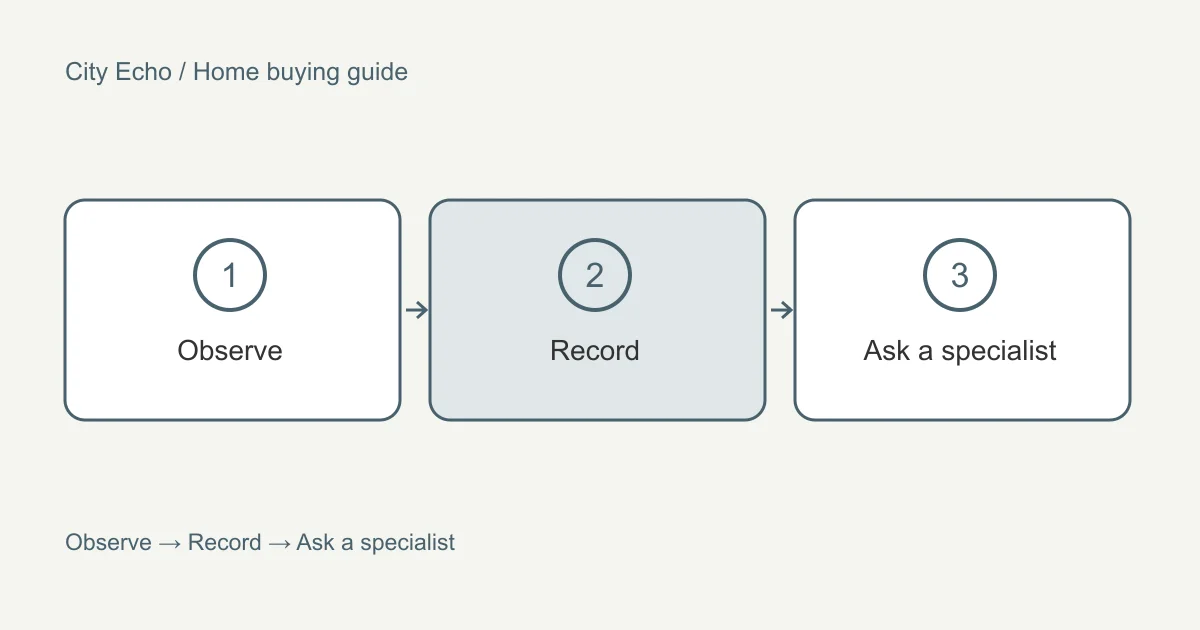
A useful house viewing produces a clear picture of practical fit and a short list of questions worth investigating. It does not need to produce a confident verdict about every visible feature. The most useful note may be the one that says what you could not assess, because it keeps an important assumption from becoming part of the purchase decision unnoticed.
This chapter sits within the home-buying guide. Use search preparation to identify the routines the home must support, and comparing homes to organise the result. If the house is part of a strata arrangement, use the strata review chapter as well.
Walk through the home as you would use it
Begin at the entrance you expect to use most often. Consider arriving with groceries, equipment, or a child, and where those things go next. Follow the route through the rooms that support your daily activities. A layout can look appealing in photographs while putting the everyday entrance, storage, and work space in an arrangement that does not fit your routine.
Check the relationship between rooms as well as their size. Where would a private conversation happen? Which route would visitors use? Could someone rest while another person works? These are personal-fit questions that you can explore without making technical claims about the building. Write the activity beside the observation so you remember why a doorway, room position, or storage area mattered.
Record alternatives you would accept. Perhaps a different furniture arrangement solves an awkward space, or another entrance works better for daily use. Keep an alternative that you have checked separate from an idea requiring alteration. If the house only works after a change, put that change on the investigation list with the information needed to decide whether it is practical.
Measure the parts that affect your routine
Before the visit, measure items you intend to keep and note the space needed around them. Ask permission to check the relevant rooms and openings. Include the route an item would take into the home when that matters. A room may accommodate the item while a doorway or turn on the route raises another question to resolve.
Keep your measurements labelled as your own notes. They serve a practical purpose and should not be presented as a professional measurement of the property. If an advertised area figure is important to your decision, ask your professional how to establish what the figure represents and what verification is appropriate. Avoid using an approximate floor plan to settle a question it was not prepared to answer.
The viewing worksheet can hold these observations alongside unanswered questions. Keep the original note when later information changes your understanding. That makes it possible to see which concern was resolved and which remains open, rather than rewriting the record until it appears that every aspect of the home was clear at the first visit.
Describe visible concerns without diagnosing them
When you notice a mark, crack, odour, uneven surface, or other concern, record where it was and what you observed. Ask before photographing it. Avoid attaching a cause unless an appropriately qualified person has established one. A note that accurately locates a concern helps the next person investigate; an unsupported diagnosis can direct the discussion toward the wrong issue.
Separate an observation from what someone tells you about it. Record the explanation, who supplied it, and whether there are documents or another source to examine. If the explanation is important to your decision, ask how it can be checked. You do not need to assume dishonesty to recognise that a verbal description and an independent assessment serve different purposes.
BCFSA's search guidance discusses property concerns and the role of investigation. Bring the observation to your professional and ask what kind of assessment may be needed. Do not treat your own silence about an unfamiliar feature as confirmation that it is satisfactory. Mark an area you could not assess and let the relevant professional explain the next step.
Treat the exterior as another set of questions
View the outdoor areas from the spaces you are permitted to access. Consider how you would reach storage, manage everyday activities, and move between the house and the street. Record the features that matter to your intended use. A garden that looks appealing may involve tasks you have not considered, while a small outdoor space may support your routine with fewer changes.
Keep technical questions separate from those preferences. Appearance alone does not establish a boundary, a right of access, or how water behaves under different conditions. Ask which records or assessments are relevant when one of those matters affects your plans. Do not infer that a fence or path proves an ownership arrangement because it appears to have been there for a long time.
The federal home inspections guide includes site features among inspection considerations. Ask your inspector about the scope relevant to the property rather than assuming every exterior issue will be covered. If another professional is needed, identify that early enough for the information to inform the decision you are approaching.
Investigate alterations and intended uses
Ask about the parts of the home that appear altered and the changes you are considering. Be specific: identify the area, the existing arrangement, and the use you intend. A broad question about whether the house has been renovated can produce an answer that does not address the feature on which your decision depends.
Request the records relevant to the question and ask your professional how to obtain or interpret them. For Vancouver, the city's property and mapping information provides a starting point for municipal research. Other municipalities have their own records and procedures. Use the authority responsible for the actual address, and avoid carrying a general statement about a neighbourhood into a parcel-specific conclusion.
Keep any income or future-use assumption outside the established facts until the underlying questions are answered. An area described as a suite, office, or additional room may raise issues beyond its appearance. Assess how the home works without the proposed benefit, then discuss the dependency with your professional. This makes the decision easier to evaluate than a single score that blends current use with an unconfirmed plan.
Arrange inspection questions with an understood scope
Consumer Protection BC provides home-inspection information and routes to licensing resources. When considering an inspector, ask about the work they will perform, the limitations, the report, and concerns that may require another specialist. Confirm the arrangements for the actual property instead of assuming that a generic description covers every feature you want assessed.
Discuss access and timing through the appropriate people. BCFSA's property inspection guidance addresses inspection questions in the transaction. The viewing appointment does not by itself establish inspection access or contract terms. Have your professional explain the arrangements and how they relate to the decision stage and deadlines involved.
After receiving a report, identify what was examined, what was inaccessible, and which findings call for follow-up. Ask the inspector to explain an unfamiliar term or the significance of a recommendation. Keep a specialist referral visible in your unresolved list. A report can be useful while still leaving a question open; treating every page as a final answer misses that distinction.
Keep a separate note of access limitations. If an area was blocked by stored items, locked, or outside the permitted viewing route, describe that limitation without speculating about what it conceals. Ask how the relevant professional would handle the limitation in an assessment. This makes the gap concrete and helps you understand whether another appointment or a different scope of work would be needed.
Turn the visit into an actionable record
Consolidate your notes before looking at the next property's photographs. Write the features that meet your brief, the compromises you would accept, and the issues that could change your interest. Put each unresolved item with a recipient and a reason it matters. A question about a room arrangement may need another visit, while a document question may need no additional time at the house.
Use a simple decision sequence: does the home meet the essential requirements, which important facts remain unresolved, and what is the next action that could resolve them? Keep the answer descriptive before assigning any score. The comparison chapter shows how to use ratings for preferences without letting them approve a property or replace professional advice.
Retain the record even if you decide to stop considering the house. A repeated issue can reveal that the search brief needs refining. Perhaps the homes you have been viewing do not provide the access or separation you actually need. That is useful progress. The next appointment should be informed by what you learned, with the same discipline about observation, evidence, and questions that remain unanswered.