

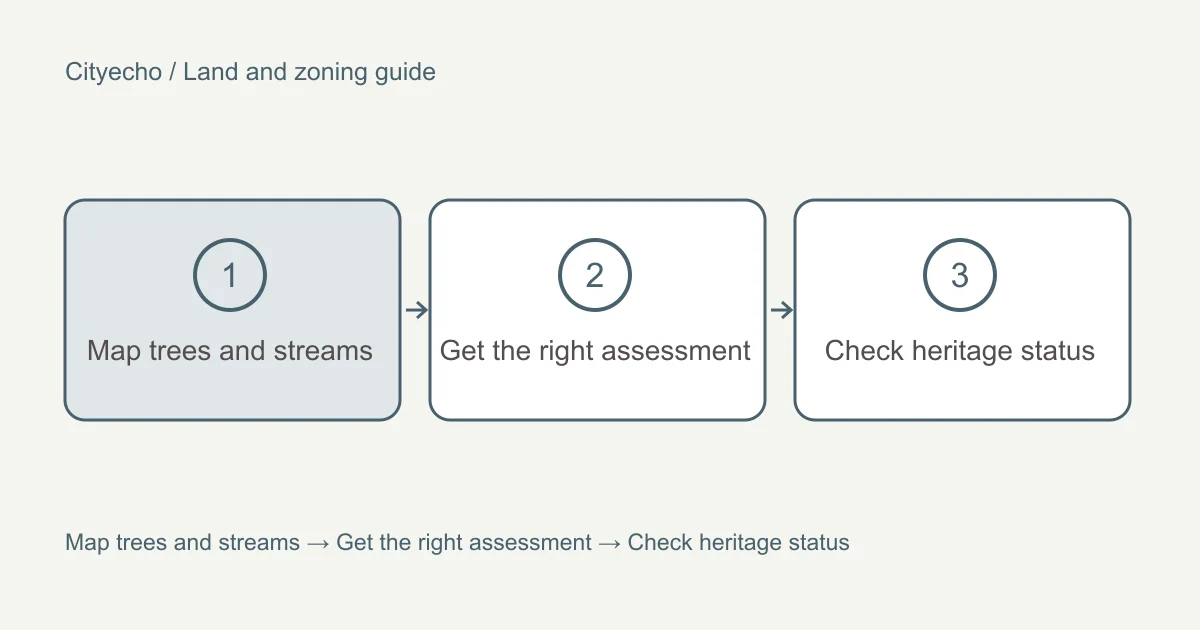
Three kinds of rules can take part of a lot out of use, or change what can be done with a house on it. Tree rules decide which trees can be removed and what must be planted. Riparian rules protect land beside streams. Heritage rules can protect a building or its site. Each has its own permit, its own professional and its own decision-maker.
This chapter of the land and zoning guide reads those rules from Coquitlam's pages and bylaws, the provincial regulation and the Local Government Act, all checked on 30 September 2026. Port Coquitlam's rules are noted where the city publishes them. Coquitlam's small-scale housing page asks owners to contact Development Services first if the house was built before 1945 or a creek or steep slope is on or next to the lot, as the small-scale housing chapter explains.
Coquitlam's tree rules
Trees on private property in Coquitlam are regulated by the Tree Management Bylaw 4091, 2010. The city's tree cutting permit page says a protected tree is any living woody plant 20 centimetres or more in diameter measured 1.4 metres from the ground, a replacement tree, or a tree planted as a requirement of development. The city's replacement chart quotes the bylaw's wider definition, which adds that trees of any size on a slope or in a streamside protection and enhancement area are always protected.
In most cases the bylaw allows an owner to remove up to two protected trees a year without a permit. More than two needs a permit. Every tree removal needs a permit if the lot has a riparian area or streamside protection area, a steep slope area, a protective covenant, or is on Burian Drive or Latimer Avenue. In those cases the application also needs a tree risk assessment by an ISA Certified Arborist.
The page sets the fees. A basic tree cutting application is $71.50. An application that needs an arborist report or a site visit by a city technician is $358. Replacement trees are bonded at $300 each, paid when the permit is issued, and 90 per cent of the bond is returned once the trees are planted and pass inspection.
Replacement trees
Coquitlam's chart bases replacement on two things: the size of the lot and the number of trees of 20 centimetres or more left after removal. The page says this chart applies to trees removed outside riparian areas, and that provincial replacement standards apply inside them.
| Lot size | Trees left after removal | Maximum replacement trees |
|---|---|---|
| Under 250 m² | 0 | 1 Class A, B or C |
| 250 to 500 m² | 0 | 2 Class A, 3 Class B or 4 Class C |
| 501 to 750 m² | 0 | 4 Class A, 6 Class B or 8 Class C |
| 501 to 750 m² | 1 | 2 Class A, 3 Class B or 4 Class C |
| 751 to 1,000 m² | 0 | 6 Class A, 9 Class B or 12 Class C |
| 1,001 to 1,250 m² | 0 | 8 Class A, 12 Class B or 16 Class C |
When more trees remain, fewer or no replacements are required. For example, a lot of 501 to 750 square metres with two or more trees left needs none. The classes group trees by their height and canopy spread at maturity. Hedge, shrub and dwarf varieties are not accepted as replacement trees.
Trees and redevelopment
Coquitlam's trees and development page says a developer may need an assessment by a certified arborist, and will likely need an arborist report with the development submission. The city treats a tree's dripline as its critical root zone, and six times the trunk diameter at 1.4 metres as its minimum protection zone. A multi-stem tree is protected if its two largest stems add up to more than 20 centimetres.
The page warns that damaging a neighbour's tree breaks the Tree Management Bylaw and may delay a development. It also sets out the provincial bird nesting rule: tree removal between 1 March and 31 August must not disturb nests. Nests of eagles, peregrine falcons, gyrfalcons, osprey, herons and burrowing owls are protected all year.
Port Coquitlam's tree cutting application says a replacement tree is mandatory for every tree removed, and two are required when the tree removed is a significant tree. A deciduous replacement must be at least 5.0 centimetres in caliper and a conifer at least 2.0 metres tall.
Streams and the provincial riparian rules
The Riparian Areas Protection Regulation applies to local governments in listed regional districts, including Metro Vancouver outside the City of Vancouver. Section 5 says a local government must not approve a riparian development unless it has received an assessment report through the province and makes the development follow that report. Section 7 says a report expires five years after the local government receives it.
Section 8 sets the riparian assessment area at 30 metres on each side of a stream, measured from the stream boundary, with wider strips for streams in ravines. Section 9 describes the streamside protection and enhancement area, the part of that strip which links the stream to the land and can support streamside plants. Section 10 says a development meets the protection standard if it stays out of that area. Existing buildings that stay on their foundations and footprints do not have to be removed.
The province's riparian areas page says the regulation calls on local governments to protect riparian areas by making sure a qualified environmental professional assesses proposed activities. It also states that amendments to the regulation come into effect on 1 January 2027. Check the rules again if your project will be decided after that date.
How Coquitlam applies the riparian rules
Coquitlam applies the regulation through section 523 of Part 5 of its Zoning Bylaw. The city may approve a development near a stream if it has mapped the protection area by the simple assessment method and the development is entirely outside it. Otherwise, it must receive a detailed assessment report from the province and make the development follow it. A federal Fisheries Act authorization is a third route.
The city's riparian summary guide, dated March 2022, says the city shows the simple assessment protection area by default for known streams on QtheMap. It says a detailed assessment by a qualified environmental professional often results in a smaller protection area than the simple method. It also says the rules apply to new homes, sheds, garages and retaining walls in the assessment area, and to subdivisions and rezonings, while work within an existing foundation footprint is outside them.
Coquitlam's development permits page adds a city permit near water. A watercourse protection development permit is required within 30 metres of the top of bank of a watercourse, or 50 metres in Northeast Coquitlam. In Port Coquitlam, the watercourse permit page says land within 50 metres of a watercourse is a development permit area, and that for most sites within 30 metres a qualified professional must locate the watercourse and top of bank.
Heritage listings and heritage designation
Heritage rules come from Part 15 of the Local Government Act. Section 598 lets a local government keep a community heritage register listing property it considers to have heritage value. Section 611 lets it designate property by bylaw. Once a property is designated, no one may alter the exterior, make a structural change, move a protected building, or build on protected land without a heritage alteration permit, unless the bylaw allows it. Section 612 requires a public hearing before a designation bylaw is adopted. Section 613 requires compensation if designation reduces the market value and the owner applies within one year.
Coquitlam's answers describe what a listing does on its own. The heritage register answers say the Community Heritage Register does not designate or protect a property, and that protection comes only from a designation bylaw, a heritage revitalization agreement or a heritage covenant. Its heritage inventory answers say the same for the inventory: the owner may alter or redevelop within the limits of other bylaws.
A heritage revitalization agreement is a formal agreement between the owner and the city, approved by Council, that protects a heritage building while allowing redevelopment. Section 610 of the act lets it vary zoning and other rules. Section 610 (2.1) says it must not vary the use or density that the small-scale housing rules require.
The Local Government Act Part 14 links heritage to small-scale housing in one more way. Section 481.4 exempts land designated under a heritage bylaw on the date that section came into force, and land protected under the Heritage Conservation Act, from the provincial minimum of three to six homes.
Before you plan near trees, water or an older house
Ask for a topographic survey that shows every tree and watercourse, then check QtheMap for the streamside layers. Ask the city whether the property is on the heritage inventory or register, or designated. The chapter on what makes a lot buildable places these checks beside slope, title and services, and the rezoning and development permits chapter explains the permits they can trigger.
For the zone rules on a lot that clears these checks, the journal article on four homes on one Coquitlam lot gives a worked example. An arborist, a qualified environmental professional and a heritage professional each answer part of the question, and the city decides each permit.