

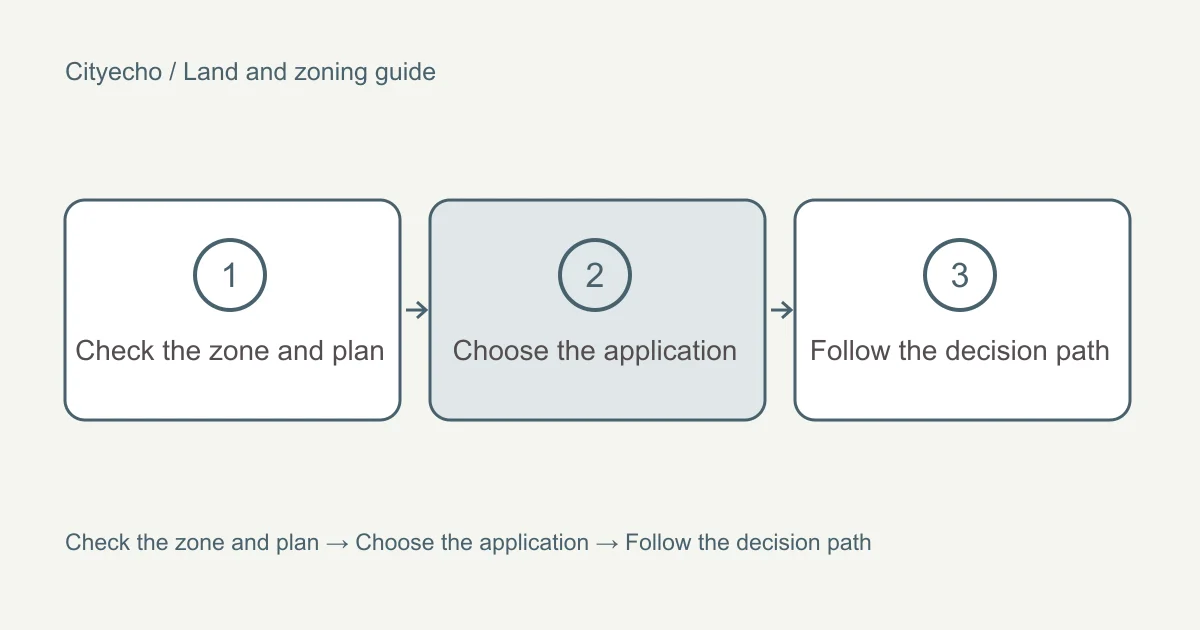
Two kinds of approval sit between a zone and a building. A rezoning changes the zone itself, which changes what the land is allowed to hold. A development permit works within the zone and controls how a building looks, where it sits and how the site is landscaped. Council decides a rezoning. Staff decide many development permits.
This chapter of the land and zoning guide explains when each is needed, what the provincial changes did to public hearings, and the steps in Coquitlam and Port Coquitlam. Every rule was checked on 30 September 2026 against the Local Government Act and the cities' own pages.
When a rezoning is still required
Since 2025, most house lots in both cities sit in zones that already permit several homes. Coquitlam's small-scale housing summary guide says the city has already zoned most low-density properties for small-scale housing, so an owner will likely not need to rezone to build it. The same guide says an owner who wants to move to another small-scale zone must apply, and must comply with the Official Community Plan.
Port Coquitlam's rezoning page states the rule plainly. Any development or building permit, and any subdivision approved by the Approving Officer, must follow the land use and density set by the Zoning Bylaw. Some regulations can be varied by a development permit or development variance permit. Land use and density cannot, so a change to either one needs a rezoning.
The common cases on a house lot are these. The owner wants more homes than the zone permits. The owner wants a building form the zone does not allow, such as townhouses in place of a fourplex. Or the lot is in a transit-oriented area and kept an older zone, so the path to a larger building is a rezoning, as the transit-oriented areas chapter explains.
The plan comes before the zone
Coquitlam's rezonings page describes two layers. The Official Community Plan assigns a land use designation to every area. The Zoning Bylaw assigns a zone to every property and sets the specific uses, density, siting, height, lot coverage and parking. The page states that any rezoning must comply with the Official Community Plan, and so must a zoning bylaw text amendment, which changes the rules for every property in a zone.
If the designation does not support the proposal, the first application is an Official Community Plan amendment. Coquitlam's Fees and Charges Bylaw No. 5484, 2025, in force from 1 January 2026, lists an Official Community Plan amendment at $10,227.90. A rezoning has a base fee of $5,691.40, plus a zone fee per 100 square metres of land, which is $38.40 for the A, R, RS, RMH, M and P zones. A pre-application review is $1,434.70.
What the province changed about public hearings
Section 464 of the Local Government Act sets the rules on public hearings for zoning bylaws. The general rule in section 464 (1) is that a local government must hold a public hearing before it adopts a zoning bylaw. Three later subsections change that.
Section 464 (2) says a local government is not required to hold a hearing if an Official Community Plan is in effect for the area and the bylaw is consistent with it. Section 464 (3) goes further. It says a local government must not hold a hearing if an Official Community Plan is in effect, the bylaw is consistent with it, the bylaw's sole purpose is to permit a development that is at least partly residential, and the residential part is at least half of the gross floor area. Section 464 (4) prohibits a hearing on a bylaw whose sole purpose is to comply with the small-scale housing rules in section 481.3.
When a hearing is not held, section 467 requires the local government to give notice. The notice must state the purpose of the bylaw, the land it affects, the date of first reading and where the bylaw can be inspected.
| Type of zoning bylaw | Public hearing under section 464 |
|---|---|
| Consistent with the plan, sole purpose a development at least half residential by floor area | Must not be held |
| Sole purpose to comply with the small-scale housing rules | Must not be held |
| Consistent with the plan, other purposes | May be waived by the local government |
| Not consistent with the plan | Required |
Port Coquitlam's page describes how it applies this. If an amending bylaw supports a development that is at least 50 per cent residential and consistent with the Official Community Plan, Council may give it three readings and a public hearing must not be held, or Council may reject it. If the bylaw is not mainly residential, Council may give first and second readings and schedule a hearing. Coquitlam's summary guide says public hearings are not required for small-scale residential rezonings consistent with the plan. Coquitlam's transit areas page lists a 22 June 2026 report on a public hearing waiver for a rezoning of small-scale lots in the Southwest Shoulders and Corridors.
What a development permit area controls
Section 488 of the act lets an Official Community Plan designate development permit areas for listed purposes. They include protecting the natural environment, protecting development from hazardous conditions, and setting objectives for the form and character of intensive residential, multi-family, commercial or industrial development. Section 489 says that inside such an area, land must not be subdivided and construction must not start until the owner has a development permit, unless the plan or zoning sets an exemption.
Section 490 sets the limits. A development permit can vary or supplement a land use bylaw, include conditions and set the sequence and timing of construction. Section 490 (3) says it must not vary the use or density of the land, except in limited cases tied to health, safety or protection of property.
Coquitlam's development permits page lists its areas. They include intensive residential, such as backyard suites, duplexes, triplexes and fourplexes, and protection from hazardous conditions, such as steep slopes. Watercourse protection areas cover land within 50 metres of the top of bank of a watercourse in Northeast Coquitlam and within 30 metres elsewhere. The page says single-family dwellings do not require a form and character development permit.
The steps in Coquitlam
Coquitlam's summary guide describes the path for small-scale housing. An optional enquiry meeting comes first. A pre-application review follows, then a formal development application that can combine a development permit, a subdivision and, if needed, a rezoning. The building permit and any demolition permit come after. Charges are paid next, then construction and an occupancy permit.
Coquitlam's development permit answers add detail for a triplex or fourplex. It needs a form and character development permit, and the General Manager of Planning and Development can approve it without Council. Once staff receive a complete application, the answers say a full review typically takes three to four months. An arborist report is required where trees are on or near the property. When the permit is approved, a notice is registered on the title.
For a rezoning, the rezonings page sets a deadline after Council's third reading. The applicant has one year from third reading to meet the requirements and obtain final adoption, or the bylaw amendment lapses. The applicant may ask to extend that year. A development application sign must be installed on the site.
The steps in Port Coquitlam
Port Coquitlam's rezoning page describes its path. The applicant can meet planning staff before applying and is encouraged to talk to neighbours. A complete application is submitted with fees, and a four foot by eight foot development sign must go up within 30 days. A staff report goes to Committee of Council, which recommends that Council approve, reject or ask for more information. The page states that a development permit cannot be approved until any related rezoning and plan amendment receive final approval.
Port Coquitlam's small-scale development permit page says lots zoned RS1 to RS4 are development permit areas. New duplexes, accessory dwelling units and projects with three or more homes need a permit before a building permit. Council has delegated these permits to the Director of Development Services. The building permit must be issued, and construction must reach the stage the page sets out, within two years of approval. A $5,000 landscape security is taken first.
Port Coquitlam's watercourse development permit page says the Official Community Plan designates land within 50 metres of watercourses as development permit areas. For most sites within 30 metres, a qualified professional must locate the watercourse and the top of bank. The chapter on trees, streams and heritage covers those rules.
Before you apply
Find the zone, the plan designation and any development permit area on the city's map. Decide whether the project fits the zone as written, needs a variance, or needs a rezoning. Ask the city for an enquiry or pre-application meeting and keep the written response. The Coquitlam residential zones chapter sets out what the small-scale zones already allow.
For a recent example of rezonings near SkyTrain, the journal article on the Southwest Shoulders and Corridors describes Coquitlam's 2026 changes. Council decides rezonings and staff decide delegated permits. An application can be approved, changed or refused, so plan around the rules as written until a decision is issued.