
Staging a Metro Vancouver Home: What It Does and Where the Money Goes
Sellers ask what staging is worth. That question is aimed at the wrong end of the process.
Almost nobody walks into your home cold. They see the photos first, on a phone, in a list beside eight other listings in the same building or on the same street.
The mechanism
The photos decide whether a viewing happens at all.
A buyer scanning search results gives each listing a second or two. If your photos do not hold that second, your home is never seen in person, and nothing about the property itself gets a chance to matter. Price, layout, the quiet back-facing bedroom: none of it reaches a buyer who scrolled past.
Judge every dollar you spend before listing against that one test. Does it change what the photos look like?
That question answers most of the spending decisions on its own.
The order of operations
The sequence matters more than the furniture. Work through it in this order:
Declutter. Everything else works better on a decluttered home, and this is the step sellers skip.
Deep clean. Windows included, especially in a unit that gets limited light. Grout, oven, inside the fridge if it stays.
Repair the small visible faults. The loose cabinet handle, the sticking door, the scuffed baseboard, the cracked switch plate, the burnt-out bulb in a fixture with three. These read in photos as a home that has been let go, even when the building and the unit are sound.
Paint, if it needs it. Walls with marks, or a colour that dominates the room, are worth a coat. Painting for its own sake is not.
Stage.
Photograph.
Most sellers run this backwards. They rent furniture for a room that still has too much in it, or they book the photographer for a Tuesday and rush the cleaning on Monday night.
Why decluttering beats buying anything
A camera lens flattens depth. A room that feels comfortable in person reads as crowded in a photo, and a crowded room reads as a small room.
Removing things is the only step that makes the space look larger without changing the property. It costs your time and, if you need it, a storage locker for a couple of months.
It also works where staging cannot reach. Open a closet in a listing photo and a buyer is reading how much storage the unit has. A closet packed to the rail says there is not enough. The same closet half empty says there is room to spare. No rented sofa does that.
Take down the personal things too. Family photos, certificates, the kids' artwork on the fridge. A buyer standing in your living room should be thinking about their own furniture in it.
The Metro Vancouver specifics
Four issues come up here more than they do elsewhere.
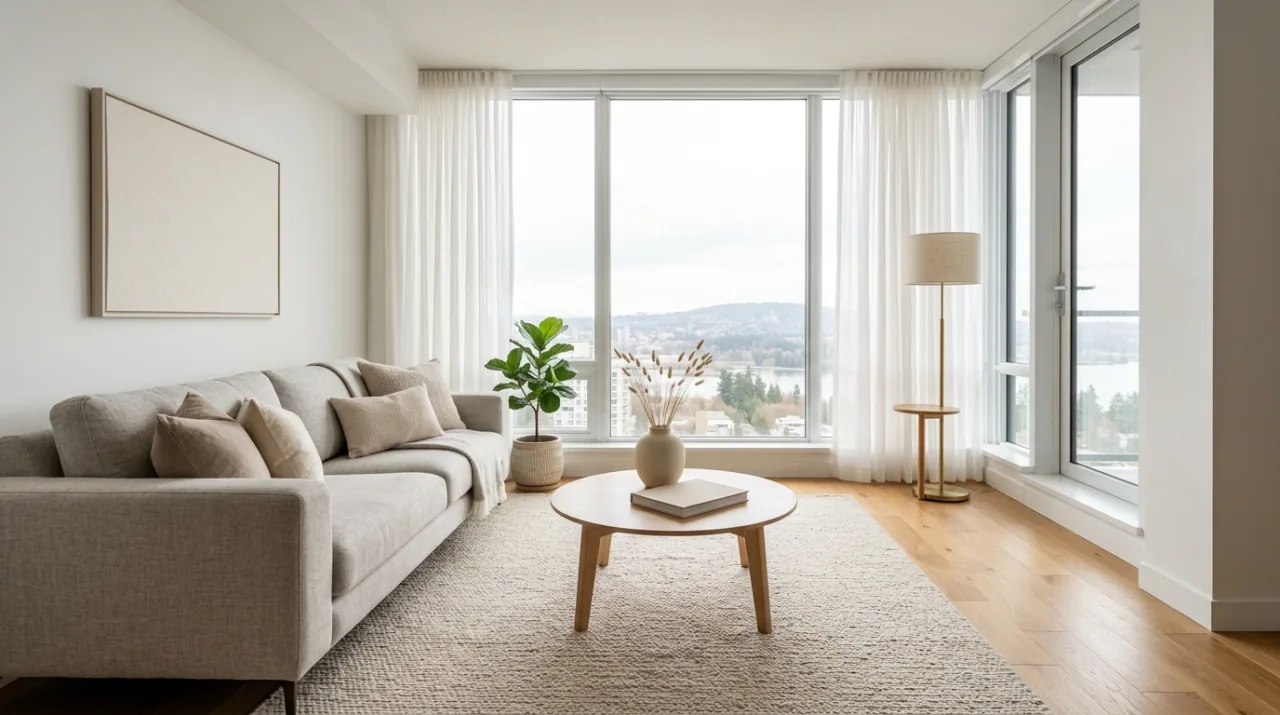
North-facing rooms and winter light. A north-facing living room in November photographs grey and flat. Book the shoot for the brightest part of the day, turn on every lamp and overhead fixture before the photographer arrives, and replace mismatched bulbs so the room does not come out half warm and half blue. Clean windows matter more here than in a south-facing unit.
Older condo kitchens and bathrooms. In a building from the eighties or nineties, the kitchen and the bathroom carry the whole impression. A dated kitchen with a clean counter, new cabinet handles, fresh caulking and a working light reads as well maintained. The same kitchen with a crowded counter and yellowed caulking reads as a renovation the buyer has to fund. If your budget is limited, spend it in those two rooms.
The balcony or patio. Outdoor space is a reason buyers choose one unit over another in this market, and it gets left out of photo sets constantly. Clear the storage off it, sweep it, put two chairs and a small table on it, and make sure it is in the photos. If there is a view, even a partial one, that is a photo on its own.
Townhome entry and street presentation. For a townhome the first photo is often the front of the unit from the street. Guest parking, a clean walkway, the front door, the number plate, a swept step. Buyers are reading how the strata is run from that image as much as they are reading your unit. The same instinct that makes people look hard at the common areas on a viewing, which we cover in reading a strata depreciation report, is at work in the first exterior photo.
The three levels of staging
Staging comes in three forms, and they answer different problems.
Consultation only, for an occupied home. A stager walks through and leaves you a list: what to remove, what to move, what to fix, which room needs a lamp. You do the work with your own furniture. This is the lowest cost version and the right one for a home that already shows well.
Partial staging of key rooms. Rented pieces go into the rooms that carry the listing, usually the living room and the primary bedroom, sometimes the dining area. It suits a home where most rooms are fine and one or two are empty, awkward, or filled with furniture that fights the space.
Full staging of a vacant home. The stager furnishes the unit from nothing. This costs the most, and it is aimed at the problem below.
Why vacant homes photograph poorly
An empty room gives the eye nothing to measure against.
A buyer looking at a bare bedroom cannot tell whether a queen bed fits with space to walk around it. They can read the floor plan, and most will not. The photo has to answer it.
Empty rooms also show every mark. Nail holes, paint touch-ups that do not match, the outline where a bookshelf stood, worn patches on the floor. Furniture and a rug take the eye off all of that.
The third problem is that empty rooms look alike. Five photos of five bare rectangles do not tell a buyer what the home is, and the listing becomes hard to remember an hour later.
Virtual staging and the labelling rule
Virtual staging adds furniture to a photo of an empty room digitally. It costs less than renting and moving real furniture, and it fixes the scale problem in the photos.
It comes with an obligation. Under Section 41 of the Real Estate Services Rules, a licensee must not publish real estate advertising that they know, or reasonably ought to know, contains a false or misleading statement or misrepresentation about the property. BCFSA's Artificial Intelligence Guideline addresses this case directly and says that photos or videos altered or enhanced with AI tools should be labelled so a buyer is not misled.
In practice that means:
- Label each virtually staged image, on the image itself.
- Keep the furniture plausible for the room, at a realistic size.
- Never remove or hide a real feature. Adding a sofa is staging. Deleting a support column, a radiator, or the neighbouring building from a window view is misrepresentation.
- Include the unstaged photo of the same room in the gallery.
The buyer will stand in the real room. A wide gap between the photo and the room costs you trust at the moment you most need it.
What not to spend on
Two categories take money from sellers and rarely come back.
Major renovations before listing. A new kitchen or a bathroom rebuild weeks before a sale is a large bill on a short timeline, and there is no reliable way to know in advance what share of it the sale price returns. Many buyers have their own plans for those rooms. If a kitchen is at the end of its life, that usually belongs in the price rather than in a rushed renovation.
Over-personalized finishes. Strong wall colours, distinctive tile, wallpaper, custom built-ins sized to your furniture. Each one narrows the group of buyers who can picture themselves living there, and taste is the one thing you cannot predict about the buyer.
What is worth doing: the small visible repairs, the deep clean, neutral paint where the walls need it, and light. Those change the photos.
For where the rest of the money question sits, price is the larger lever, and pricing in a balanced market covers how that gets set from comparable sales.
The sequence with your agent
Order matters at the end too.
Photos first. The home is at its best on the day of the shoot, and that day should be chosen for light.
Floor plan next. A measured floor plan answers the questions photos cannot: room dimensions, how the unit flows, where the storage sits. Buyers comparing two units in the same building use it more than any single photo.
Then the listing goes live. A listing published before the photos are ready spends its highest-attention days looking unfinished. The buyers already searching your area, the ones with alerts set, see it once when it first appears. That first impression is the one you are staging for.
If you are selling in a specific area, what buyers are comparing you against matters to how you present. Our neighbourhood pieces, like the Lower Lonsdale condo buyer's guide, show the kind of comparison a buyer is running while your photos are on screen.
What this comes down to
- Staging works through the listing photos, which decide whether a viewing is booked.
- The order is declutter, clean, repair, paint, stage, photograph.
- Decluttering does more than any purchase, because a lens flattens depth.
- Spend the limited budget on the kitchen, the bathroom, and light.
- Put the balcony or patio in the photo set.
- Three levels exist: consultation, partial, full vacant staging.
- Virtually staged images must be labelled, under Section 41 of the Real Estate Services Rules and BCFSA's Artificial Intelligence Guideline.
- Skip major pre-listing renovations and personalized finishes.
- Publish in this order: photos, floor plan, listing.
- Contact our team to plan the pre-listing work on your address, or browse listings to see how comparable homes are being presented.
Plan your next step
Look at comparing homes to see what buyers weigh when two listings sit side by side, which is the comparison your photos have to survive. If your property is in a strata, strata review covers the documents buyers read once your photos have done their job.
Frequently asked questions
What does staging actually do?
It changes what your listing photos look like, and the photos decide whether a buyer books a viewing. A buyer scrolling a search results page on a phone gives each listing a second or two before moving on. Staging is the work that makes your home hold that second long enough for someone to open it.
Is staging worth the cost?
That depends on your starting point. An empty condo with no furniture and a north-facing living room benefits from staging more than an occupied home that already shows well. Ask your agent what the photos will look like without it, because that is the thing staging changes.
What should I do first?
Declutter, before you buy or rent anything. Then deep clean, then repair the small visible faults, then paint if the walls need it, then stage, then photograph. Doing it in that order means each step works on a surface that is already ready for it, and the photography happens once.
Why does decluttering beat buying new furniture?
A camera lens flattens depth, so a full room reads as a small room in a photo. Removing things makes the space read as larger without changing anything about the property. It also costs nothing beyond your time and some storage, which is why it is the first thing to do rather than the last.
What are the three levels of staging?
A consultation, where a stager walks your occupied home and gives you a list of what to remove, move, and fix. Partial staging, where rented pieces go into the rooms that carry the listing, usually the living room and primary bedroom. Full staging of a vacant home, where the stager furnishes the whole unit.
Do empty homes photograph badly?
Usually, yes. An empty room gives the eye no sense of scale, so buyers cannot tell whether a bedroom takes a queen bed. Bare walls and floors also show every mark, and the photos tend to come out as a series of similar-looking boxes that are hard to tell apart.
Do I have to disclose virtual staging?
Photos that have been altered or enhanced should be labelled so a buyer is not misled. BCFSA's Artificial Intelligence Guideline says this directly for AI staging tools, and Section 41 of the Real Estate Services Rules prohibits a licensee from publishing advertising that contains a false or misleading statement about the property. A clear caption on each altered image is the working standard.
Is virtual staging a substitute for real staging?
It solves the scale problem in the photos and costs less than renting furniture. It does nothing for the buyer standing in the empty room at the viewing, and a large gap between the photo and the room can work against you. It fits best where the room is sound and the issue is only that it is empty.
What should I not spend money on before listing?
Major renovations you will not recover in the sale price, and finishes chosen to your own taste. A full kitchen replacement weeks before listing is a large bill on a short timeline, and the buyer may have planned their own kitchen anyway. Bold tile, strong wall colours, and built-ins narrow the pool of buyers who can picture themselves in the space.
In what order does the listing go live?
Photos first, then the floor plan, then the listing is published. A listing that goes live with placeholder photos or none at all spends its highest-attention days looking unfinished, and those early days are when the buyers already searching your area see it for the first time.